
Three Short Philosophical Passages That Will Blow Your Mind
3- Nietzsche to avoid disenchantment.

Why read complicated books?
Because as Haruki Murakami says,
“if you only read the books that everyone else is reading, you can only think what everyone else is thinking.”
That’s why I’m writing this article: to get you out of your routine. To make you think about different concepts. To make your day unique.
Let’s get started.
1. Hegel for happiness.
The whole is an immobile equilibrium of all the parts, and each piece is a spirit in its midst which does not seek its satisfaction beyond itself but possesses it in itself because it is itself in this equilibrium with the whole. — G.W.F Hegel, Phenomenology of Spirit, Madrid, Abada, 2018, p. 545.
Every action reacts. What was precedes what is in the same way that what is precedes what will be.
Therefore everything is intertwined. And for it to work, each of us has to play our role in the world. Hence you seek fulfillment.
Fulfillment for you is a primal drive that keeps you alive. You pursue it instinctively because only then will you find that balance and be helpful to the whole.
We may think we want to stand out from others, but the only thing we pursue is meaning: that our existence has meaning.
You are an autonomous being that depends on the whole and uses it to fulfill its objectives, but you can only complete yourself within yourself.
You do not seek fulfillment beyond yourself not because you do not want to but because you cannot. Think about it: you can only experience sensations within your physical self.
You can spend Christmas Eve working in a soup kitchen, alleviating the hunger and suffering of hundreds of homeless people. But you can only feel satisfaction within yourself.
Practical application of this reflection:
You can only experience as much pleasure, fulfillment, pain, suffering, happiness as your body and spirit allow.
Do you realize this?
You cannot be happy by making others happy. You are pleased by experiencing the feeling of making others happy. The act is a trigger, but the happiness occurs within you.
In the same way that an insult cannot hurt you, only your internal representation of that insult. The feelings that are born within you when you feel wronged.
The point is-and this is what blows your mind-that depending on your body, emotions, and thoughts, you can increase or decrease the intensity of what happens to you daily.
It’s what we do when we practice mindfulness while we eat, and we are aware of every texture, every taste, every smell.
It is what happens when we breathe deeply and prepare our bodies to relax and feel pleasure.
It’s what happens when we abstract from the comments of others so we can move forward.
We have an emotional thermostat, which allows us to turn the intensity up and down at will. We have to train it. And your life will change.
That is why it is essential not to neglect our physical and emotional health. We are like an instrument that has to be well-tuned to sound good.
Suppose you fill your body with junk food, inactivity, and junk content; in that case, apathy will alter the laboratory inside you. No matter how many positive acts you perform, you will not experience happiness; or experience it with less intensity.
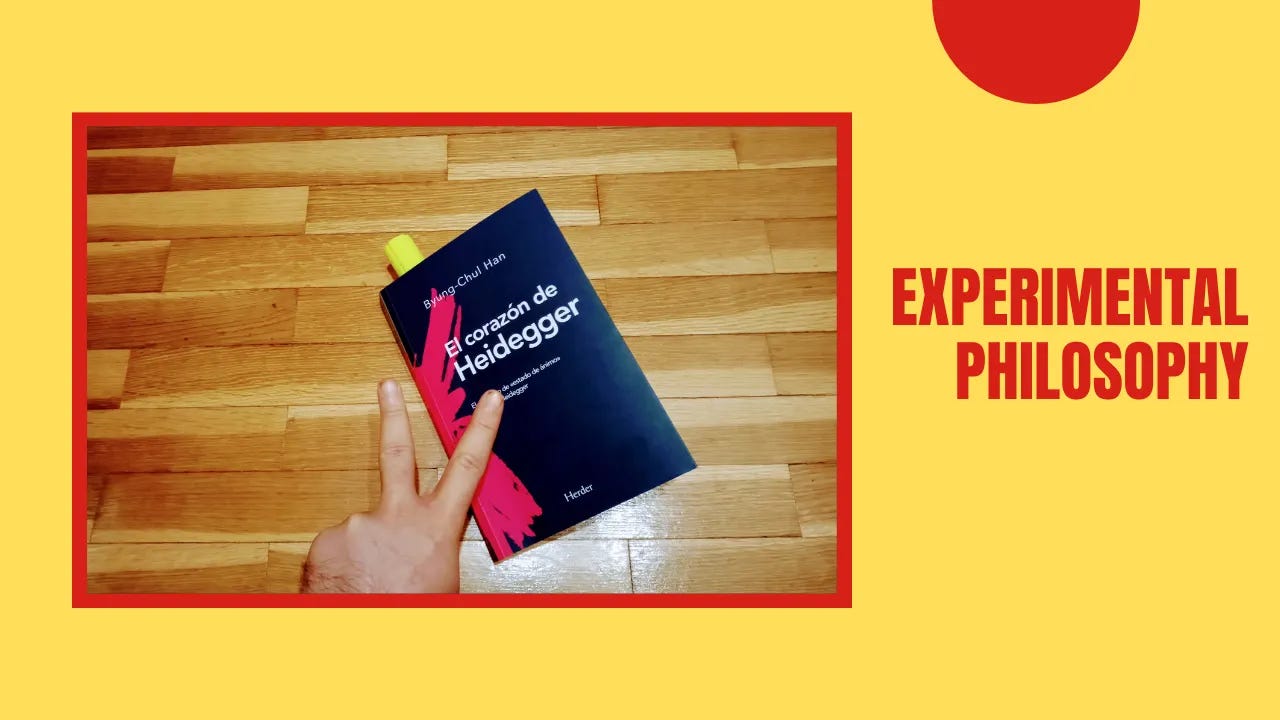
2. Heidegger for better your life.
